Prolific donor Trump, often skirted rules, paid fines





Washington (CNN)Criticism
about Donald Trump's donation to Florida Attorney General Pam Bondi has
renewed focus on Trump's history of political giving, sparking
questions of whether he was serious earlier in his campaign when he
bragged of being able to buy politicians.
In
the decades before he became a politician, Trump was often on the other
side of the fence, trying to influence them in critical battles and
occasionally breaking some laws in the process.
In
the midst of a casino battle with the St. Regis Mohawk tribe of New
York in 2000, Trump and longtime adviser Roger Stone were fined $250,000
after a group Trump and Stone started aired radio ads critics said were
racist. The spots, sponsored by the "Institute for Law and Society,"
accused the Mohawk tribe of being involved in drug smuggling, money
laundering and trafficking illegal immigrants.
The ads ended with the narrator saying, "Are these the kinds of neighbors we want?"
The
group was a fake institute, ultimately tied to Trump. Trump and Stone
paid the largest fine levied by New York lobbying regulators at that
time, while never admitting guilt.
In
other cases during the 1980s, Trump gave loan and set up subsidiaries
which skirted campaign finance limits. In testimony to the New York
State Commission on Government Integrity in 1988, Trump said he did not
see anything wrong with it because he assumed others understood what he
was doing and that it was what his lawyers suggested.
But
since taking to the campaign trail, Trump has taken a very different
tone, saying that he was buying politicians at the time with his many
donations and saying that proved politics was corrupt.
"I
give to everybody. When they call, I give. And do you know what? When I
need something from them two years later, three years later, I call
them, they are there for me," Trump said at a Republican debate last
August hosted by Fox News.
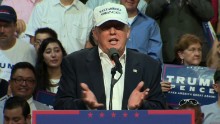
During a rally in Iowa earlier this year, Trump said he had to give big donations so that politicians would do what he wanted.
"I've
given to Democrats, I've given to Hillary, I've given to everybody
because that was my job. I gotta give to them, because when I want
something I get it. When I call, they kiss my ass. It's true," Trump
said.
The Trump campaign did not
comment specifically on the prior violations, or whether Trump stood by
his previous comments that he routinely bought politicians.
But
Trump aides pointed to a string of articles showing that Trump was
never accused of wrongdoing by the New York ethics panel in 1988 and did
not admit any wrongdoing after paying the fine in the Mohawk tribe
case.
Questions about Trump's
political giving rocketed to the spotlight this week after he was fined
$2,500 for donating to Bondi through his charitable foundation while
Bondi's office was deciding whether to investigate Trump University.
Hillary
Clinton, who has been under fire over questions of whether donors to
her family's foundation were given special access, blasted Trump during a
talk with reporters Tuesday.
Both Trump and Bondi have denied any wrongdoing. Bondi, in an interview with Fox Business News Tuesday, was defiant, saying she wouldn't be "bullied" by Clinton.
But
Democrats have used the fine as an opening to go at Trump with just two
weeks until the election. Democratic groups supporting Clinton have
been blasting out stories about Trump and Bondi and a New York Times review of Trump's previous campaign violations.
The
Federal Election Commission included Trump's violation of a $25,000
limit in the 1988 elections in a case study of its worse violations, "Selected List of Cases."
A lawyer for Trump said that he had given $47,000 -- well in excess of
the limit -- and then failed when he attempted to correct the mistake by
asking for the donations back.
He
was fined $15,000 for the violation. (Trump aides pointed to Trump
comments from 1993 where he said he would have fought the fine, but
paying the money was easier.)
At
least one expert said that Trump's violations may not be the worst ever
recorded (the FEC also lists serious violations by President Barack
Obama's campaign, the Senate Democrats' campaign arm and others) but
Trump's violations do stick out.
"Campaign
violations are not routine in the sense that it's not true that every
candidate or every giver commits a violation. But they do happen," said
Larry Noble, a veteran government ethics lawyer and former counsel to
the FEC. "Some of them are routine, or of a traffic ticket nature,
others are more serious."
In the
same decade, Trump was called before a New York state commission
investigating public corruption and campaign donations to discuss
donations he made to Andrew Stein, who was running for New York City
Council president at the time.
Trump
testified that he gave a $50,000 loan to Stein in 1985, but ultimately
repaid his own loan after Stein did not immediately repay. New York
rules capped total donations by an individual at $50,000.
"I was under the impression I was getting my money back," Trump told the ethics commission at the time, according to a New York Times report.
Later
in his testimony, Trump detailed how he gave another $50,000 to Stein
using 18 different subsidiaries which avoided donation limits. He told
the ethics panel that he expected everyone knew the subsidiaries were
really him and that he did it that way because it was what his lawyers
advised, according to a separate New York Newsday account of his
testimony from 1988.


No comments:
Post a Comment