Jan 1, 2013 ... Such floods are likely caused by atmospheric rivers: narrow bands of ... A January 15, 1862, report from the Nelson Point Correspondence ...
Great Flood of 1862
From Wikipedia, the free encyclopedia
The
Great Flood of 1862 was the largest flood in the
recorded history of
Oregon,
Nevada, and
California,
occurring from December 1861 to January 1862. It was preceded by weeks
of continuous rains and snows in the very high elevations that began in
Oregon in November 1861 and continued into January 1862. This was
followed by a record amount of rain from January 9–12, and contributed
to a flood which extended from the
Columbia River southward in western Oregon, and through California to
San Diego, and extended as far inland as
Idaho in the
Washington Territory,
Nevada and
Utah in the
Utah Territory, and
Arizona in the western
New Mexico Territory. Immense snowfalls in the mountains of the far western United States caused more flooding in Idaho, Arizona,
New Mexico, and
Sonora, Mexico the following spring and summer as the snow melted.
The event was capped by a warm intense storm which melted the high
snow load. The resulting snow-melt flooded valleys, inundated or swept
away towns, mills, dams, flumes, houses, fences, and domestic animals,
and ruined fields.
Maybe later
|Close
 Dear readers, time is running out in 2016 to help Wikipedia.
To protect our independence, we'll never run ads. We're sustained by
donations averaging about $15. Only a tiny portion of our readers give. If everyone reading this right now gave $3,
our fundraiser would be done within an hour. That's right, the price of
a cup of coffee is all we need. We're a non-profit with costs of a top
ten website. If Wikipedia is useful to you, please take one minute to
keep it online and growing. Thank you.
Donate now
Dear readers, time is running out in 2016 to help Wikipedia.
To protect our independence, we'll never run ads. We're sustained by
donations averaging about $15. Only a tiny portion of our readers give. If everyone reading this right now gave $3,
our fundraiser would be done within an hour. That's right, the price of
a cup of coffee is all we need. We're a non-profit with costs of a top
ten website. If Wikipedia is useful to you, please take one minute to
keep it online and growing. Thank you.
Donate now
Background
A map of the flood area of the hypothetical
ARkStorm event
The weather pattern that caused this flood was not from an
El Niño type event, and from the existing Army and private weather records, it has been determined that the polar
jet stream was to the north as the
Pacific Northwest
experienced a mild rainy pattern for the first half of December 1861.
In 2012, hydrologists and weather experts concluded that the
precipitation was likely caused by a series of
atmospheric rivers that hit the Western United States along the entire West Coast, from Oregon to Southern California.
[1]
An atmospheric river is a narrow band of water vapor about a mile above
sea level and about 400 to 600 kilometres (250 to 370 mi) wide.
[2][3]
Prior to the flooding, Oregon had steady but heavier than normal rainfall during November and heavier snow in the mountains.
[4]:76–83
Researchers believe the jet stream slid south accompanied by freezing
conditions reported at Oregon stations by December 25. Heavy rainfall
began falling in California as the
longwave
trough moved down over the state, remaining there until the end of
January 1862 and causing precipitation everywhere in the state for
nearly 40 days. Eventually the trough moved even further south, causing
snow to fall in the
Central Valley and surrounding mountain ranges.
[5]
Oregon
There was
an excess of precipitation in November 1861 over most of Oregon, less
so in the extreme northwest. It was cold enough at the higher elevations
that much snow fell in the
Cascade Range, which when later melted by the warm rains produced a great quantity of water that flooded into the
Willamette River and other streams in the Cascades. Tributaries of the Willamette rising in the
Oregon Coast Range
did not rise so high. Then the depression that came in at the beginning
of December produced strong, warm southerly winds in Oregon, with
extremely heavy rain. The crest of the flood was reached at
Salem on December 3; at
Oregon City on the 4th; at
Milwaukie, between Oregon City and
Portland, on the 5th; at
Albany
on December 8, a second rise at Albany greater than the first. The
crest at Albany and Salem were the highest ever known at any time. In
Oregon, the flood was one of the largest in the history of the
Willamette Valley and the rest of Western Oregon. Flooding was heaviest on rivers with tributaries arising from the snow-covered Cascade Range.
[4]
An article in the December 14, 1861,
Oregon City Argus, described the course of the flood at Oregon City:
| “ |
During
the month of November the rain had been falling almost continuously,
and a vast amount of snow must have accumulated in the mountains...
Tuesday evening a gloom settled on a scene such as probably never was
witnessed in our Valley before. The ceaseless roar of the stream made a
fearful elemental music widely different from the ordinary monotone of
the Falls; while the darkness was only made more visible by the glare of
torches and hurrying lights, which with the shouts of people from the
windows of houses surrounded by the water, all conspired to render the
hour one of intense and painful excitement. The flood has covered the
highest mark of January '53, and is still rapidly rising. As late as
anything could be seen the mills were still standing, but the insatiate
monster is still creeping up inch by inch, winding its swelling folds
round the pillars and foundations of all the houses in its way, crushing
and grinding them in the maw of destruction, and sweeping the broken
fragments into a common vortex of ruin. All night as on the night
previous, people whose homes were being invaded hurried to places of
security, glad to escape even with the sacrifice of all their goods.
The light of Wednesday morning revealed a scene of desolation
terrible in its extent no less than in its completeness. The Oregon City
and Island Mills, Willamette Iron Works, Foundry and Machine Shop were
all gone...[4]:76–77 |
” |
Flood waters were so high that at Oregon City at the flood's crest on December 5, the steamer
St. Clair
was able to run the falls, and steamers were able to visit points at
some distance from the normal river channel. Although large amounts of
wheat and flour were swept away, some was recovered when Oregon City's
Island Mill was found on
Sauvie Island downriver from Portland. The nearby town of
Linn City was completely destroyed by flooding and was not rebuilt.
[6] In addition, the flood destroyed the historic town of
Champoeg, site of the first provisional government in Oregon, and
Orleans, across the Willamette River from
Corvallis. Neither was rebuilt.
[4]:78
The flooding was also severe in other parts of Oregon; the
Umpqua River
had the greatest flood known even to the oldest Native Americans, and
water was 10 to 15 feet (3.0 to 4.6 m) higher than the 1853 flood. It
rose from November 3 to December 3, subsided for two days, then rose
again until the 9th. At Fort Umpqua, communication upriver was cut off
above Scottsburg, and the river was full of floating houses, barns,
rails and produce. At
Port Orford, the
Coquille River swept away settlers' property and also did great damage on the
Rogue River and on other small streams."
[4]:78–79
Flood damage was so great because the rivers in Oregon were the main
routes of travel. The river front was the building site of mills,
freight depots, and storehouses for grain and other foodstuffs. Business
houses and many residences were near the landings. Farm buildings were
mostly on sites convenient to the rivers, along with supplies of feed
for livestock. Loss of so much wheat flour and demand from the new Idaho
gold fields caused a spike in its price from $7 to $12 per barrel.
Idaho
In the interior of
Washington Territory, in what is now
Idaho,
the storm creating the flood in Oregon dumped its precipitation as an
unprecedented snowfall. Flooding on the Columbia River and the snow in
the mountains closed off supplies to the new mining towns on the
Salmon River, causing starvation among the miners of
Florence,
cut off from December until May 1862. In early July, as the heavy
burden of snow in the mountains melted, the runoff caused great
flooding. The
Boise River
flooded from extremely high runoff and is believed to have been four
times larger than its largest recorded flood in 1943. Flood waters made
the river expand to a couple of miles wide.
[7] It washed away or covered the original route of the
Oregon Trail in the river valley.
[8]
California
California
was hit by a combination of incessant rain, snow, and then unseasonally
high temperatures. In Northern California, it snowed heavily during the
later part of November and the first few days of December, when the
temperature rose unusually high, until it began to rain. There were four
distinct rainy periods: The first occurred on December 9, 1861, the
second on December 23–28, the third on January 9–12, and the fourth on
January 15–17.
[9]
Native Americans knew that the Sacramento Valley could become an inland
sea when the rains came. Their storytellers described water filling the
valley from the Coast Range to the Sierra.
[10]
Northern California
Fort Ter-Waw, located in
Klamath, California, was destroyed by the flood in December 1861 and abandoned on June 10, 1862.
[11] Bridges were washed away in
Trinity and
Shasta counties.
[12]
At Red Dog in Nevada County, William Begole reported that from December
23 to January 22 it rained a total of 25.5 inches (65 cm), and on
January 10 and 11 alone, it rained over 11 inches (28 cm).
[9]
At
Weaverville,
John Carr was a witness to the sudden melt of snow by the heavy rain
and onset of the flood in December 1861 on the Trinity River:
| “ |
From
November until the latter part of March there was a succession of storms
and floods... The ground was covered with snow 1 foot (0.30 m) deep,
and on the mountains much deeper... The water in the river
... seemed like some mighty uncontrollable monster of destruction
broken away from its bonds, rushing uncontrollably on, and everywhere
carrying ruin and destruction in its course. When rising, the river
seemed highest in the middle... From the head settlement to the mouth of
the Trinity River, for a distance of one hundred and fifty miles,
everything was swept to destruction. Not a bridge was left, or a
mining-wheel or a sluce-box. Parts of ranches and miners cabins met the
same fate. The labor of hundreds of men, and their savings of years,
invested in bridges, mines and ranches, were all swept away. In
forty-eight hours the valley of the Trinity was left desolate. The
county never recovered from that disastrous flood. Many of the
mining-wheels and bridges were never rebuilt.[13] |
” |
Two years later
William H. Brewer saw near
Crescent City, the debris of the flood:
| “ |
The
floods of two years ago brought down an immense amount of driftwood from
all the rivers along the coast, and it was cast up along this part of
the coast in quantities that stagger belief. It looked to me as if I saw
enough in ten miles along the shore to make a million cords of wood....
One I measured was 210 feet long and 3 1/2 feet at the little end,
without the bark.[14]:495 |
” |
Central Valley
The entire Sacramento and
San Joaquin valleys were inundated. An area about 300 miles (480 km) long, averaging 20 miles (32 km) in width,
[15] and covering 5,000 to 6,000 square miles (13,000 to 16,000 km
2) was under water.
[9]
The water flooding the Central Valley reached depths up to 30 feet
(9.1 m), completely submerging telegraph poles that had just been
installed between San Francisco and New York. Transportation, mail, and
communications across the state were disrupted for a month.
[16] Water covered portions of the valley from December 1861, through the spring, and into the summer of 1862.
[9]
| “ |
The
rainy season commenced on the 8th of November, and for four weeks, with
scarcely any intermission, the rain continued to fall very gently in San
Francisco, but in heavy showers in the interior. According to the
statement of a Grass Valley paper, nine inches of rain fell there in
thirty-six hours on the 7th and 8th inst.... the next day the river-beds
were full almost to the hilltops. The North Fork of the American River at Auburn
rose thirty-five feet, and in many other mountain streams the rise was
almost as great. On the 9th the flood reached the low land of the Sacramento Valley.[4] |
” |
In
Knight's Ferry, in the foothills of the Sierra Nevada astride the
Stanislaus River,
about 40 miles (64 km) east of Modesto, the town's homes, its mill, and
most of its businesses were ruined by the flood. The bridge spanning
the river initially withstood the flood waters but was destroyed when
the debris of the bridge at Two-Mile Bar, only a short distance up
river, torn from its foundation, crashed into the Knights Ferry Bridge,
crushing the truss supports and knocking it from its rock foundation.
[17]
All Sacramento, excepting one street, part of Marysville, part of Santa
Rosa, part of Auburn, part of Sonora, part of Nevada City, and part of
Napa were under water.
[18] Some smaller towns like
Empire City and
Mokelumne City were entirely destroyed.
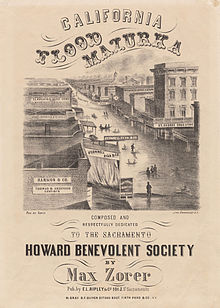
Sacramento
Sheet music cover depicting Sacramento flooding
Sacramento,
sited at the junction of the Sacramento and American Rivers, was
originally built at 16 feet (4.9 m) above low-water mark, and the river
usually rose 17 to 18 feet (5.2 to 5.5 m) almost every year. The
New York Times
reported on January 21, 1862 that a trapper who had spent more than 20
years in California had frequently boated over the city's site, and in
1846, the water at the location was 7 feet (2.1 m) deep for sixty days.
[18]
On 27 December 1861, the Sacramento River reached a flood level of
22 feet 7 inches (6.88 m) above the low water mark, after rising 10 feet
(3.0 m) during the past 24 hours.
[9]
The city of
Sacramento suffered the worst damage due to its
levee, which lay in a wide and flat valley at the junction of the
American and
Sacramento
rivers. When the floodwaters entered from the higher ground on the
east, the levee acted as a dam to keep the water in the city rather than
let it flow out. Soon the water level was 10 feet (3.0 m) higher inside
than the level of the Sacramento River on the outside.
[4]
John Carr wrote of his riverboat trip up the Sacramento River when it was at one of its highest stages of flood:
| “ |
... I was a passenger on the old steamer Gem, from Sacramento to Red Bluff.
The only way the pilot could tell where the channel of the river was,
was by the cottonwood trees on each side of the river. The boat had to
stop several times and take men out of the tops of trees and off the
roofs of houses. In our trip up the river we met property of every
description floating down—dead horses and cattle, sheep, hogs, houses,
haystacks, household furniture, and everything imaginable was on its way
for the ocean. Arriving at Red Bluff, there was water everywhere as far
as the eye could reach, and what few bridges there had been in the
country were all swept away.[4] |
” |
Dozens of wood houses, some two stories high, were simply lifted up
and carried off by the flood, as was "all the firewood, most of the
fences and sheds, all the poultry, cats, rats and many of the cows and
horses". The Chinese in their poorly built
shantytowns were disproportionately affected.
[9]
A
chain gang
was sent to break open the levee, which, when it finally broke, allowed
the waters to rush out of the city center and lowered the level of the
flooding by 5–6 feet (1.5–1.8 m). Eventually the waters fell to a level
on a par with the lowest part of the city.
[4] From January 23, 1861, the state capital was moved from flooded Sacramento to San Francisco.
[9]
Southern California
In
Southern California, beginning on December 24, 1861, it rained for 28 days in
Los Angeles.
[14]:243 In the
San Gabriel Mountains the mining town of
Eldoradoville was washed away by flood waters.
[19] The flooding drowned thousands of cattle and washed away fruit trees and vineyards that grew along the
Los Angeles River. No mail was received at Los Angeles for five weeks.
The Los Angeles Star reported that:
| “ |
The road from Tejon,
we hear, has been almost washed away. The San Fernando mountain cannot
be crossed except by the old trail ... over the top of the mountain. The
plain has been cut up into gulches and arroyos, and streams are rushing
down every declivity.[20] |
” |
The plains of Los Angeles County, at the time a marshy area with many
small lakes and several meandering streams from the mountains, were
extensively flooded, and much of the agricultural development that lay
along the rivers was ruined. In most of the lower areas, small
settlements were submerged. These flooded areas formed into a large lake
system with many small streams. A few more powerful currents cut
channels across the plain and carried the runoff to the sea.
In Los Angeles County, (including what is now
Orange County) the flooding
Santa Ana River created an inland sea lasting about three weeks with water standing 4 feet (1.2 m) deep up to 4 miles (6 km) from the river.
[15] In February 1862, the Los Angeles,
San Gabriel, and Santa Ana Rivers merged. Government surveys at the time indicated that a solid expanse of water covered the area from
Signal Hill to
Huntington Beach, a distance of approximately 18 miles (29 km).
[21]:38
At
Santa Barbara County, the narrow coastal plains were flooded by the rivers coming out of the mountains. The
San Buenaventura Mission Aqueduct that was still drawing water from a tributary of the Ventura River for the town of
Ventura water system, was abandoned due to the damage in the area that become the separate
Ventura County in 1873.
[22]
In
San Bernardino County, all the fertile riverside fields and all but the church and one house of the
New Mexican colony of
Agua Mansa,
were swept away by the Santa Ana River, which overflowed its banks.
Father Borgotta ringing the church bell on the night of January 22,
1862, alerted the inhabitants to the approach of the flood, and all
escaped.
[23]
In
San Diego, a storm at sea backed up the flood water running into the bay from the
San Diego River, resulting in a new river channel cut into
San Diego Harbor.
The continuous heavy downpour also changed the look of the land, the
previously rounded hills were extensively cut by gulleys and canyons.
[21]
To the north, in the
Owens Valley, similar snow and flooding conditions as those to the east in
Aurora, Nevada
(see below), led to the local Paiute suffering the loss of much of the
game they depended on. Cattle newly driven into the valley to feed the
miners, competed with the native grazers and ate the native wild plant
crops the Paiute depended on to survive. Starving, the Paiute began to
kill the cattle and conflict with the cattlemen began, leading to the
subsequent
Owens Valley Indian War.
Economic impact
On March 1862, the Wool Growers Association reported that 100,000 sheep and 500,000 lambs were killed by the floods. Even
oyster beds
in San Francisco Bay near Oakland were reported to be dying from the
effects of the immense amounts of freshwater entering the bay. Full of
sediment, it covered the oyster beds.
[9]
One-quarter of California's estimated 800,000 cattle were killed by the
flood, accelerating the end of the cattle-based ranchero society.
One-fourth
[9] to one-third of the state’s property was destroyed, and one home in eight was carried away or ruined by the flood-waters.
[16] Mining equipment such as sluices, flumes, wheels and derricks were carried away across the state.
[9]
An early estimate of property damage was $10 million.
[18]
However, later it was estimated that approximately one-quarter of the
taxable real estate in the state of California was destroyed in the
flood. Dependent on
property taxes,
the State of California went bankrupt. The governor, state legislature,
and state employees were not paid for a year and a half.
[24]
Nevada
The
Carson River Basin of the eastern California and western
Utah Territory (now
Nevada),
suffered from a similar pattern of flooding. Flooding began in December
1861 in Carson Valley from a series of storms in the upper Carson River
basin. Two feet (61 cm) of wet heavy snow fell on December 20, 1861,
accumulating on the valley floor. Snow was followed by a period of very
cold temperatures which froze the snow, followed by a three-day rain
starting on December 25, 1861. By January 2, 1862, the town of
Dayton and the area surrounding it had been flooded.
[25]
In the vicinity of
Aurora,
there had been light snowfall in November, then mild weather until
Christmas Eve, when there began a heavy and rapid snowfall for days. The
temperature dropped below zero and the passes over the
Sierras
were closed. During the second week of January, it warmed slightly, and
the snow became a torrential rain. Esmerelda and Willow gulches
overflowed their banks and flooded Aurora. With water standing up to 3
inches (76 mm) deep in many buildings, adobe buildings turned to mud and
collapsed. After a week, it cooled again, and snow began to fall again.
Within a few days, the snow was deeper than it had been before the
rains had begun to fall. Samuel Young of Aurora recorded in his diary
that the snow and rain had fallen for 26 days out of 30 since
December 24, 1861.
[26]
Utah
The early southwestern
Utah settlements in
Washington County:
Fort Clara,
St. George,
Grafton,
Duncans Retreat,
Adventure, and
Northrop were nearly destroyed by a flood on the
Virgin and
Santa Clara Rivers, that followed 44 days of rainfall in January and February 1862.
[27] Survivors of Fort Clara established the modern town of
Santa Clara a mile east of the old fort on the Santa Clara River.
[28] Springdale and
Rockville were founded in 1862 by settlers flooded out of Adventure, Northup and other places in the vicinity.
[27]
Settlers were driven from
Fort Harmony when the fort had to be abandoned after most of its adobe walls were washed away during this flood.
New Harmony and
Kanarraville, in
Iron County, were the settlements created by refugees from this disaster later in 1862.
[29]:174
Arizona
In western
New Mexico Territory, heavy rains fell in late January, causing severe flooding of the
Colorado River and
Gila River.
On January 20, 1862, the Colorado River began to rise, and on the
afternoon of January 22 it rose suddenly in three hours from an already
high stage nearly 6 feet (1.8 m), overflowing its banks and turned
Fort Yuma in
California into an island in the midst of the Colorado River. At 1 o’clock on the morning of January 23, the river reached its crest.
[30] Jaeger City a mile down river from Fort Yuma, and
Colorado City, across the
Colorado River
from it were washed away. The river overflowed its banks to the extent
that there was water 20 feet (6.1 m) deep on a ranch in the low-lying
ground just above
Arizona City where the Gila River joined the Colorado. The riverside home of steamboat entrepreneur
George Alonzo Johnson and the nearby Hooper residence were the only places in the town unharmed because they were built on high ground.
[31] Colorado City had to be rebuilt on higher ground after the 1862 flood.
[32]
The Gila River also flooded, covering its whole valley at its mouth
where it met the Colorado from the sand hills on the south to the
foothills on the north. Twenty miles (32 km) to the east of Fort Yuma,
it swept away most of the mining boomtown of
Gila City along with a supply of hay being gathered there to supply the planned advance of the
California Column into
Confederate Arizona.
Further east the road was flooded, buildings and vehicles swept away
and traffic was disrupted for some time thereafter by the mud covering
the road to Tucson.
[33]
The great flood in the Gila and Colorado rivers, covered their bottom
lands with mud. Much of the livestock along the rivers drowned and the
crops of the Indians along the river were destroyed.
[34]
The overflow of the 1862 Colorado River spring flood waters reached the
Salton Sink via the
Alamo and
New Rivers, filling it and creating a lake some 60 miles (97 km) long and 30 miles (48 km) wide.
[35]
New Mexico
The great snow pack laid down during the winter of 1861–62, in the southern
Rocky Mountains, and other ranges, the sources of the
Rio Grande, caused a great spring flood in that river that changed its course in the
Mesilla Valley. The flood also impeded the operations of the
California Column attempting to cut off the retreating
Confederate Army of New Mexico. On July 8, 1862, Lt. Col.
Edward E. Eyre,
First California Volunteer Cavalry wrote:
| “ |
The Rio Grande has been unusually high this summer, almost the entire bottom between Fort Craig and Mesilla
being still overflowed. It is impossible at this time to approach
Mesilla on the west side of the river, a new channel having been washed
out on that side of the town, through which the largest portion of the
water flows; besides, the bottom for a long distance is overflowed, and,
the soil being of a loose nature, animals mire down in attempting to
get through it.[36] |
” |
Instead of crossing at Messilla, the high waters and course change
forced Eyers detachment to cross the Rio Grande, up river at the old
San Diego Crossing below
Fort Thorn, after waiting another week for the water to go down, which allowed the rearguard of the Confederate Army to escape into
Texas. Messilla, built on the west bank of the Rio Grande after the
Mexican American War, was left by the movement of the river on its east bank where it remains today.
Sonora, Mexico
Until the Great Flood of 1862, what became
Port Isabel Slough, in
Sonora, Mexico,
was a shallow tidewater slough, but the extreme flood waters of that
year cut its channel much deeper, so that at low tide it still was three
fathoms deep. The mouth of this slough was only 5 miles (8.0 km) from
the mouth of the river and sheltered from the extremes of the
tidal bore of the Colorado River and deep enough to prevent stranding on
shoals or
mud flats at low tide.
[37] This made it an ideal anchorage for maritime craft to load and unload their cargo and passengers from the
steamboats that took them up and down river without the danger from the tides that they were having to risk in the
estuary at
Robinson's Landing.
In the month of March 1865, the
schooner Isabel, from
San Francisco, commanded by
W. H. Pierson, found and entered this slough and discharged her cargo there for the first time. Subsequently, the steamers,
sailing ships and later ocean-going
steamships loaded and off-loaded their cargoes there, and the steamboat company established
Port Isabel 2.5 miles (4.0 km) above the mouth of the slough. The port lasted until 1878. After the
Southern Pacific Railroad reached Yuma, it was abandoned the following year, the shipyard there being removed to Yuma.
[38]
Future implications
In recent years, the flood has held the attention of the
United States Geological Survey
and emergency planners, who use it as an example when modelling the
impact of a similar event happening in modern-day California. The
official name for such an event is "
The Arkstorm", and it is unofficially called "The other big one".
[39][40]
The storm is not an isolated occurrence. Geologic evidence has been
found that massive floods, caused by rainfall alone, have occurred in
California every 100 to 200 years,
[16] and
climate change could cause them to happen more frequently.
[41]
References




No comments:
Post a Comment