begin quote from:
GOP distances itself from Trump -- again
| CNN | - |
So
Trump sought to do the heavy lifting himself Monday, delivering a
feisty speech here that attempted to reframe the campaign and extract
him from the quagmire of the past week, which included a disappointing
debate performance, a roiling controversy ...
GOP distances itself from Trump -- again








Story highlights
- Trump attempts to reframe himself as a fighter in Colorado
- Clinton questions Trump's business skills in Ohio
Pueblo, Colorado (CNN)Donald
Trump -- struggling to move past a week of one controversy after
another -- is making clear that he's willing to go it alone in the final
weeks of the campaign.
As the
Republican nominee tries to recover from one of his toughest stretches,
few prominent GOP leaders -- other than those who advise him or are on
his payroll -- seem willing to launch a full-throated rescue effort.
So
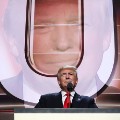
Trump sought to do the heavy lifting himself Monday, delivering a
feisty speech here that attempted to reframe the campaign and extract
him from the quagmire of the past week, which included a disappointing
debate performance, a roiling controversy over whether he paid taxes,
and ill-advised attacks on a Latina beauty queen -- a feud he couldn't
seem to let go.
With a new CNN/ORC poll showing
Democratic nominee Hillary Clinton with a five-point lead over Trump
after the debate, Trump for the first time seemed to relish the role of
underdog in the presidential race. He mounted an unapologetic defense of
his business record, previewing lines he might deploy during his
rematch with Clinton on Sunday.
Responding
to a stunning New York Times report over the weekend that he may have
paid no taxes for the last 18 years, Trump acknowledged here that he had
been a "big beneficiary" of "the unfairness of the tax laws." He
acknowledged that he "brilliantly" used U.S. tax laws to pay as little
in federal income taxes as possible.
'I'm working for you now'

Donald Trump: I'm working for you now, not for Trump 01:23
But, he added to an appreciative crowd, "I'm working for you now, I'm not working for Trump."
Indeed,
the day was all about Trump as few prominent Republicans rushed to his
defense. House Speaker Paul Ryan, a policy wonk who once chaired the
tax-writing House Ways and Means Committee, was the most senior lawmaker
to address Trump's troubles Monday in comments that were relatively
tepid.
"I don't think it's that harmful," he told local reporters in Michigan, according to the Detroit Free Press. "I think people who don't like him are going to continue disliking him."
Back
in Colorado, Trump took on the stance of a fighter as he detailed his
financial troubles in the 1990s -- which he described as a "bad time"
and an "ugly time" -- boasting that he never considered giving up, and
compared his own losses to those of working class voters across America.
"When the odds are stacked
against me and you -- because many of you people are the same way --
when people say it can't be done, that's when we just get started,"
Trump said. "We are looking for a comeback."
"The
thing that motivates me the most is when people tell me something is
absolutely impossible," Trump said. "For me, impossible is just a
starting point."
Across
the country at Clinton's event in Ohio -- a state that may be beyond
her reach despite its bellwether status in past elections -- the former
secretary of state sharply pointed out that it was difficult for Trump
to claim stellar business skills after declaring $916 million in losses
in his 1995 tax records, according to the weekend report in the New York
Times.

Clinton: What kind of genius loses a billion dollars? 01:20
"Here is my question: What kind of genius loses a billion dollars in a single year?" Clinton asked.
Verge of unraveling
Before
attempting to reframe his life story as one of resilience and
overcoming obstacles, Trump's campaign seemed at the verge of unraveling
this week, once again sending GOP lawmakers slinking away from their
flailing nominee, as they try to contain the collateral damage to
vulnerable House and Senate candidates.
Somewhat
laughably, Trump blamed the fact that he failed to prosecute his case
against Clinton in the first debate on a faulty microphone. He then
attempted a Twitter takedown of former Miss Universe Alicia Machado, a
Clinton supporter who he had once criticized as overweight. Before long
he was mired in the controversy over The New York Times story that found
his reported losses may have resulted in him not paying federal income
taxes for 18 years.
CNN has not
independently verified the documents' authenticity, but Trump's campaign
has not challenged any of the facts reported by The Times.
Trump's
apparent self-sabotage -- or perhaps merely tone-deafness -- continued
Monday morning at a forum in Virginia with the Retired American Warriors
PAC where he seemed to suggest that U.S. soldiers and veterans commit
suicide because "they can't handle" post-traumatic stress or weren't
strong enough.

























At
the same forum, he also pointedly questioned the U.S. approach to
defeating ISIS, wondering aloud whether airstrikes by the U.S. and its
allies are actually taking out members of ISIS.
"We
don't have victory," Trump said at the veterans' forum in Virginia.
"We're dropping things all over the place. Who knows what they are
hitting? Who knows how many people are being killed? Who knows if
they're the right people?"
As
Trump's comments about PTSD blazed across social media, news reports
emerged that New York's (Democratic) Attorney General issued a cease-and-desist letter to
Trump's charitable foundation, ordering it to stop raising money in the
state after a series of reports about the foundation's questionable
spending.
Gleeful Democrats
While
most Republicans were silent Monday, Democrats were gleeful -- doing
their part to stir up the uproar over Trump's comments about PTSD, with
even the White House weighing in.
"The
commander in chief made a firm declaration that it is not a sign of
weakness to get help," White House spokesman Josh Earnest said, alluding
to President Barack Obama's comments during a town hall with service
members last week moderated by CNN's Jake Tapper.
"In
fact, it's a sign of character, and a sign of strength to ensure that
you are taking care of yourself. And the president has acknowledged the
cultural barriers in the military to changing attitudes about this,"
Earnest said.
For
much of the past month, Republican leaders believed that Trump was
finally on message and making an effective case against Clinton. His
poll numbers rose, giving a boost to GOP senators down-ticket while
improving Republican prospects of keeping the House.
But
his feud with Machado, renewed questions over his taxes and his rocky
performance at the first debate have once again renewed long-standing
concerns within GOP ranks that their standard bearer remains an
unpredictable wild card when it comes to their party down-ticket.
"Every
prediction I've made has been wrong about Mr. Trump and his impact,"
said Sen. John Cornyn, the No. 2 Republican, who told CNN earlier this
year that Trump could be an "albatross" for his party.
Asked
about the next debate, Cornyn said: "We'd like to see him do better.
Obviously, he doesn't have as much experience as Secretary Clinton — and
it showed" at the Hofstra debate.
Asked
about Trump's attacks on Machado, Sen. John Barrasso of Wyoming, the
No. 4 Senate Republican, said Trump "is at his best" when he focuses on
economic issues and national security -- not personal matters.
"I
would focus on Hillary's record on politics of 30 years," Barrasso said
when asked about Trump bringing up Bill Clinton's sex scandals. "This
is a change election -- change versus more of the same and this country
cannot afford to have the next four years to be like the last eight
years with Obama."
Sen. Bill
Cassidy of Louisiana also said Trump needs to re-engage on the issues
that drove up his poll numbers in late August and early September.
"You
know I can't comment on that, it's not what I would do," Cassidy said
when asked about Trump relitigating the Clinton scandals from the 1990s.
"I think people know that. Folks now — they're hurting and they want to
know somebody understands."
Indeed,
GOP leaders publicly and privately have long shown a level of
discomfort with Trump's unorthodox campaign — especially in the
aftermath of last week's events.
At
a press conference to wrap up the pre-election congressional session,
Senate Majority Leader Mitch McConnell would not talk about Trump's
impact on the battle for the Senate majority.
"Look
to avoid wasting our time here," McConnell told reporters, "this is not
something I'm going to discuss today -- the implications of the
presidential race on the Senate."
Asked why he wouldn't answer Trump questions, McConnell said flatly: "Because I choose not to.


No comments:
Post a Comment