23 hours ago ... The Russian ambassador to Turkey has been shot dead by a police officer in an Ankara art gallery on Monday night. Andrei Karlov was ... The Guardian ... Russian ambassador shot dead in Turkey art gallery – video report.
6 hours ago ...Turkey and Russia stress their desire for cooperation after Andrei Karlov shot by off-duty police officer Mevlut Mert Altıntas. ... The Guardian · home; › world; › ... Russian ambassador to Turkey shot dead in Ankara art gallery.
The Russian ambassador to Turkey has been shot dead by a police officer who shouted “Don’t forget Aleppo” as he pulled the trigger.
The chilling attack on Monday evening, which was captured on video,
appeared to be a backlash against Russian military involvement in the
Syrian civil war.
Andrei Karlov was attacked at the opening of an art exhibition in
Ankara by a man believed to be an off-duty Turkish police officer.
Karlov was several minutes into a speech when he was shot. Footage of
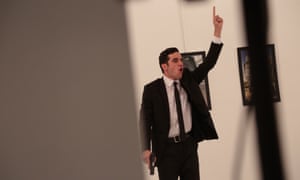
the attack showed a man dressed in a suit and tie standing calmly behind
the ambassador. He then pulled out a gun, shouted “Allahu Akbar” and
fired at least eight shots.
After firing at the ambassador, the man shouted in Turkish: “Don’t forget Aleppo. Don’t forget Syria.
Unless our towns are secure, you won’t enjoy security. Only death can
take me from here. Everyone who is involved in this suffering will pay a
price.”
He also shouted in Arabic: “We are the one who pledged allegiance to Muhammad, to wage jihad.”
The Russian president, Vladimir Putin, called the killing a
“provocation” aimed at sabotaging a rapprochement between Moscow and
Ankara and attempts to resolve the conflict in Syria.
“The crime that was committed is without doubt a provocation aimed at
disrupting the normalisation of Russian-Turkish relations and
disrupting the peace process in Syria that is being actively advanced by
Russia, Turkey and Iran,” he said in televised comments.
Putin said: “There can be only one answer to this - stepping up the fight against terrorism, and the bandits will feel this.”
Putin said that Russian officials would be dispatched to Ankara to
investigate the killing. “We have to know who directed the hand of the
killer,” he said.
His comments were echoed by Russian foreign minister Sergey Lavrov
who said, following a phone call with his Turkish counterpart, Mevlut
Cavusgolu, that those behind the shooting “were seeking to derail the
process of normalising Russia-Turkey ties primarily with a goal to
prevent an efficient fight against terrorism in Syria.”
Lavrov will meet with the foreign ministers of Iran and Turkey later on Tuesday to discuss Syria.
The attacker was killed by Turkish special forces after they
surrounded the gallery. Photographs from the aftermath appeared to show
him lying dead on the floor. Three other people were wounded.
The gunman gestures after shooting Karlov. Photograph: Burhan Ozbilici/AP
Local media outlets said security guards at the scene had told them
that the killer showed a police ID to enter the gallery. The Turkish
interior ministry named the attacker as Mevlut Mert Altıntas, an officer
in Ankara’s riot police squad, who was born in 1994 in Aydin and
graduated from Izmir police academy.
Advertisement
The
shooter’s family home in the western province of Aydin was later
searched and his mother, father and sister were detained, according to
Turkey’s state-run Anadolu news agency. . Altıntas’s house in Ankara was
raided and his roommate, also a police officer, was also taken into
custody, it said.
“It has saddened us and our people. I offer my condolences to the
Russian federation and the Russian people,” Suleyman Soylu, the Turkish
interior minster, told reporters.
The Turkish president, Recep Tayyip Erdoğan, called Putin on Monday evening to brief him on the attack.
The Russian president cancelled a planned trip to the theatre on
Monday evening and called an urgent meeting with his foreign minister,
Sergei Lavrov, and the heads of the security services.
In a bizarre coincidence, Putin had planned to see the play Woe from
Wit, written by the poet and diplomat Alexander Griboyedov, who was
murdered by a mob when ambassador to Tehran in 1829.
Konstantin Kosachev, the head of the foreign relations committee in
Russia’s upper house of parliament, said: “A tragedy of this scale has
not happened since the time of Griboyedov. There have been attacks on
our Russian and Soviet diplomats, but not something this dramatic.”
Kosachev said the repercussions of the killing on Russian-Turkish
relations would depend on the details of the incident: “It could have
been a planned terrorist attack by extremists or it could be the work of
a lone maniac. After we know, we’ll be able to understand how this will
affect Russian-Turkish relations.”
Kosachev’s counterpart in the lower house, Alexey Pushkov, said
Karlov’s death was “a result of political and media hysteria around
Aleppo sown by the enemies of Russia”.
Turkish security officials and Erdoğan supporters have alleged that
the gunman was linked to the exiled Turkish cleric Fethullah Gülen, whom
they accuse of orchestrating a failed coup in July. A spokesman for
Gülen described the accusation as “laughable” and told Reuters that it
was intended to cover up for lax security.
Later on Monday a gunman had attempted to enter the US embassy in
Ankara and fired eight shots into the air. The man was overpowered by
security guards and taken into custody by police. No one was hurt in the
incident. The embassy said its missions in Ankara, Istanbul and the
southern city of Adana would be “closed for normal operations on
Tuesday.”
Internationally, the killing of Karlov throws into doubt the ongoing
evacuation deal for civilians in besieged east Aleppo, an agreement that
was brokered by Turkey and Russia. A source with knowledge of the
negotiations said Moscow was the main reason the deal did not fall apart
over the weekend, despite the objections of Iranian and jihadi
interlocutors.
The ambassador had been part of discussions with Turkey that led to
an evacuation of east Aleppo getting under way late last week. Russia
and Iran engineered the deal allowing civilians and rebel fighters in
Aleppo to be evacuated, with Turkey acting as the brokers for the Syrian
opposition in the discussion.
Advertisement
The
attack comes the day before the Turkish foreign minister, Mevlüt
Çavuşoğlu, is due in Moscow for Syria talks with his Russian and Iranian
counterparts. In the weeks running up to the fall of east Aleppo, the
Russians, Turks and Iranians have increasingly been working together on
Syria’s future, to the exclusion of western powers, including the US, as
well as the Gulf states, normally the sponsors of the Syrian
opposition.
Putin has sought to capitalise on his new role as the lead power in
Syria by proposing wider Syrian peace talks at a meeting in Astana, the
capital of Kazakhstan, to be attended by Russia, Turkey and Iran on 27
December. Putin insisted his proposal would not conflict with the United
Nations process in Geneva, but instead complement it. He wants to forge
a Turkish, Iranian and Russian axis before Donald Trump’s inauguration.
Many Syrian opposition figures fear they will be marginalised by the Putin initiative and his new triumvirate.
In his time as ambassador, Karlov presided over a rocky period in Russo-Turkish relations. When Turkey shot down a Russian fighter plane in November 2015, Moscow responded furiously, with Putin calling it “a stab in the back by the accomplices of terrorists”.
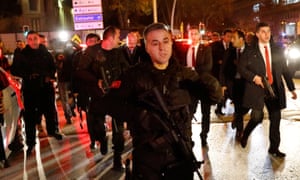
Turkish police secure the area near the art gallery. Photograph: Umit Bektas/Reuters
Earlier this year, the pair reconciled, after Erdoğan wrote a letter
of apology to Putin. The two leaders met at a summit in August amid a distinct thaw in relations and in what resembles a loose anti-western alliance.
Kosachev, who knew Karlov personally, said: “The Turkish period in
his career saw fantastic highs and lows. Everyone was hoping for another
high.”
However, Russian actions in Syria have angered many Turks. In recent
days, protests in Istanbul against Russian involvement in Syria and
Aleppo, including a demonstration in front of the Russian consulate on
the city’s famed İstiklal Avenue, have occurred on a regular basis. The
protests have often had a significant Islamist contingent.
The assassination of the Russian ambassador, and the security lapse
that allowed it to happen, will anger Putin but, in the medium term, it
is possible that the two leaders could unite in an anti-terror alliance.
Fatih Öke, the former press attache of Turkey’s embassy in Washington DC, tweeted:
“The bullet to Ambassador Karlov is not only aims him. It aims also
Turkish Russian relation. We are praying for his good health and peace.”
Trump said in a statement: “Today we offer our condolences to the
family and loved ones of Russian Ambassador to Turkey Andrei Karlov, who
was assassinated by a radical Islamic terrorist. The murder of an
ambassador is a violation of all rules of civilized order and must be
universally condemned.”
The US state department spokesman, John Kirby, said: “We condemn this
act of violence, whatever its source. Our thoughts and prayers are with
him and his family.” Karlov was a career diplomat who had previously served as ambassador to North Korea. The British ambassador to Turkey, Richard Moore, described him as a “quietly spoken, hospitable professional”. Additional reporting by Ceren Kenar


No comments:
Post a Comment