Piroshki
Cafe and Bakery uses authentic Russian recipes, offers breakfast and
lunch menus, and has two convenient locations in downtown Seattle.
begin quote from:
Pirozhki
From Wikipedia, the free encyclopedia
Pirozhki (
Russian:
пирожки, plural form of
pirozhok, literally a "small pie"), sometimes transliterated as
pyrizhki or
pyrizhky (
Ukrainian:
пиріжки), is a generic word for individual-sized baked or fried buns stuffed with a variety of fillings. The stress in
pirozhki is properly placed on the last syllable:
[pʲirɐʂˈkʲi].
Pirozhok (
 пирожок (help·info)
, singular) is the
diminutive form of the Russian
pirog (пирог), which refers to a full-sized
pie. Pirozhki are not to be confused with
Polish pierogi, which are similar to the
Russian pelmeni or
Ukrainian varenyky.
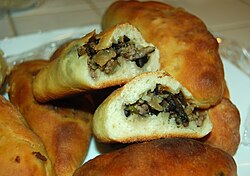
A common variety of pirozhki are baked stuffed buns made from yeast
dough and often glazed with egg to produce the common golden colour.
They commonly contain meat (typically beef) or a vegetable filling
(mashed potatoes, mushrooms, onions and egg, or cabbage). Pirozhki could
also be stuffed with fish (e.g., salmon) or with an oatmeal filling
mixed with meat or
giblets. Sweet-based fillings could include stewed or fresh fruit (apples, cherries, apricots, chopped lemon, etc.), jam,
quark or
cottage cheese.
The buns may be plain and stuffed with the filling, or else be made in a
free-form style with strips of dough decoratively encasing the filling.
Potatoes among
American crops
became very popular when the vegetable was brought and adopted to the
Eurasian climate. Before then, the ingredient was not available as it
took more time to acclimatize to
continental
regions like Russia and Ukraine. Before then, the ingredients would
contain more vegetables and fruits, as well as duck, goose and rabbit
meat, uncommon today.
[citation needed]
Regional varieties
The Balkans
The
Greek variety
piroski (
Greek:
πιροσκί)
is popular in parts of Greece influenced by eastern cuisine and in most
big cities, where they are sold as a type of fast food. The Greek
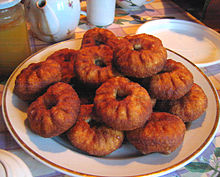
piroski come deep-fried with many different stuffings.
[1]
In
Serbia the local variety are cylindrical pastries called piroška. They are stuffed with fillings such as ground spiced meat mix of
pork and
veal or cottage cheese, and with
kulen, tomato sauce and herbs. Alternatively they are made from breaded
crepes with variety of fillings.
The Baltic region
In
Latvia crescent-shaped buns of leavened dough called
pīrāgi (often referred to in diminutive
pīrādziņi) or
speķa rauši (literally, "bacon tarts") are traditionally filled with bacon and onion. Other fillings are also possible.
[2] However the name
pīrāgi is not exclusive to these buns, but can refer to variety of other pastries, such as
pies and
turnovers.
Pīrāgi were often eaten as lunch by farmers and shepherds working the fields.
Estonians too have this tradition. The
pirukad are fairly small in size and have regional variations in respect to fillings.
Pirukad
are sometimes accompanied by bouillon. Many recipes exist, with meat,
cabbage, carrots, rice, egg and other fillings and filling mixtures also
being used. The Latvian bacon and onion version is known to Estonians,
but is not as common. One can also encounter sweet fillings, although
savory
pirukad predominate.
Finland
Karelian pasties (
karjalanpiirakat/
karjalanpiirakka in the
South Karelian dialect of
Finnish and
karjalanpiiraat/
karjalanpiiras in the
North Karelian dialect) are a differently shaped pie popular in both
Karelia and
Finland. Compared to the Baltic pirukas and pīrāgi, the Karelian pastries are open-faced.
Central Asia
Pirozhki are common as fast food on the streets of the Central Asian
countries in Kazakhstan, Tajikistan, Uzbekistan, Turkmenistan,
Kyrgyzstan, where they were introduced by the Russians. They are also
made by many Russians and non-Russians at home.
East Asia
Pirozhki is also very common as fast food in
Mongolia, and it is made throughout the country by families at home.
Caucasus and Iranian Azerbaijan
The Russian variant of Pirozhki is a common fast food in
Armenia and
Azerbaijan.
In Armenia it often contains a potato or seasoned meat filling. In
Azerbaijan, it is often eaten as a dessert and is commonly filled with
cream.
Iran
An Iranian version, called پیراشکی (
pirāški) is often eaten as a
dessert or as a
street food.
It is commonly filled with cream, but potato and meat fillings are also
available in some shops. The Iranian sweet shops in Los Angeles have
invented other versions such as chocolate and blueberries.
Japan
A Japanese version, called ピロシキ (
piroshiki), are predominantly fried, use fillings such as
ground meat, boiled egg,
bean noodles, spring onion etc., and are commonly breaded with
panko before frying, in the manner of Japanese
menchi-katsu. Another popular variation is filled with
Japanese curry and is quite similar to
karē-pan, which is itself said to be inspired by pirozhki.
The Americas
Varieties of pirozhki were brought to the New World by
Volga Germans. Known today as
bierock,
pirok or
runza, they belong to several regional cuisines in the United States, Canada and Argentina.
See also
Notes


 Cookbook: Pirozhki
  Media: Pirozhki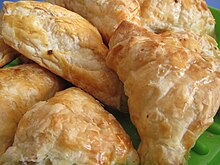



No comments:
Post a Comment