The history of sugar has five main phases: The extraction of sugar cane juice from the sugarcane plant; and, the subsequent domestication of the plant in tropical ...
History of sugar
From Wikipedia, the free encyclopedia
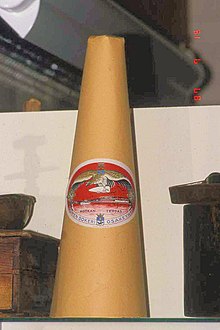
A
sugarloaf
was the traditional shape of sugar in the eighteenth century: a
semi-hard sugar cone that required a sugar axe or hammer to break up and
sugar nips to reduce to usable pieces
The
history of sugar has five main phases:
- The extraction of sugar cane juice from the sugarcane
plant; and, the subsequent domestication of the plant in tropical
Southeast Asia many thousands of years ago (a firm date is unknown).
- The invention of manufacture of cane sugar granules from the
sugarcane juice in India a little over two thousand years ago, followed
by improvements in refining the crystal granules in India in the early
centuries A.D.
- The spread of cultivation and manufacture of cane sugar to the
medieval Islamic world together with some improvements of production
methods.
- The spread of cultivation and manufacture of cane sugar to the West
Indies and tropical parts of the Americas beginning in the 16th century,
followed by more intensive improvements in production in the 17th
through 19th centuries in that part of the world.
- The development of beet sugar, high fructose corn syrup and other sweeteners in the 19th and 20th centuries.
Worldwide through the end of the
medieval period, sugar was very expensive
[1] and was considered a "
fine spice",
but from about the year 1500, technological improvements and New World
sources began turning it into a much cheaper bulk commodity.
The spread of sugar cane cultivation
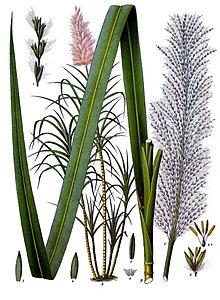
The people of
New Guinea were probably the first to
domesticate sugarcane, sometime around 8,000 BC.
[citation needed]
However, the extraction and purifying technology techniques were
developed by people who were living in India. After domestication, its
cultivation spread rapidly to
Southeast Asia and
southern China.
India,
where the process of refining cane juice into granulated crystals was
developed, was often visited by imperial convoys (such as those from
China) to learn about cultivation and sugar refining.
By the sixth century AD, sugar cultivation and processing had reached
Persia; and, from there that knowledge was brought into the
Mediterranean by the Arab expansion. "Wherever they went, the [medieval] Arabs brought with them sugar, the product and the technology of its production."
Spanish and Portuguese exploration and conquest in the fifteenth century carried sugar south-west of
Iberia.
Henry the Navigator introduced cane to
Madeira in 1425, while the Spanish, having eventually subdued the
Canary Islands, introduced sugar cane to them. In 1493, on his second voyage,
Christopher Columbus carried sugarcane seedlings to the
New World, in particular
Hispaniola.
Early use of sugarcane in India
Originally, people chewed sugarcane raw to extract its sweetness.
Indians discovered how to crystallize sugar during the
Gupta dynasty, around 350 AD. sugarcane was originally from tropical
South Asia and
Southeast Asia. Different species likely originated in different locations with
S. barberi originating in
India and
S. edule and
S. officinarum coming from
New Guinea.
Indian sailors, consumers of clarified butter and sugar, carried sugar by various
trade routes. Traveling Buddhist monks brought sugar crystallization methods to China. During the reign of
Harsha (r. 606–647) in
North India, Indian envoys in
Tang China taught sugarcane cultivation methods after
Emperor Taizong of Tang
(r. 626–649) made his interest in sugar known, and China soon
established its first sugarcane cultivation in the seventh century. Chinese documents confirm at least two missions to India, initiated in 647 AD, for obtaining technology for sugar-refining. In South Asia, the
Middle East and
China, sugar became a staple of cooking and
desserts.
In the year 1792, sugar rose by degrees to an enormous price in Great
Britain. The East India Company was then called upon to lend their
assistance to help in the lowering of the price of sugar. On the 15th of
March 1792, his Majesty's Ministers to the British Parliament,
presented a report related to the production of refined sugar in British
India. Lieutenant J. Paterson, of the Bengal establishment, reported
that refined sugar could be produced in India
[13] with many superior advantages, and a lot more cheaply than in the West Indies.
Early refining methods involved grinding or pounding the cane in
order to extract the juice, and then boiling down the juice or drying it
in the sun to yield sugary solids that looked like
gravel. The Sanskrit word for "sugar" (
sharkara) also means "gravel" or "sand". Similarly, the
Chinese use the term "gravel sugar" (
Traditional Chinese: 砂糖) for what the West knows as "table sugar".
Cane sugar in the medieval era in the Muslim World and Europe
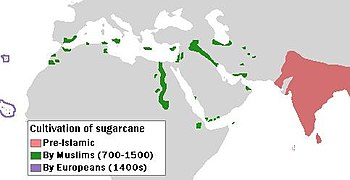
The westward diffusion of sugarcane in pre-Islamic times (shown in red), in the medieval
Muslim world (green) and by Europeans in the 15th century (islands circled by violet lines)
[14]
There are records of knowledge of sugar among the ancient Greeks and
Romans, but only as an imported medicine, and not as a food. For
example,
Dioscorides in Greece in the 1st century (AD) wrote: "There is a kind of coalesced honey called
sakcharon [i.e. sugar] found in reeds in India and
Arabia Felix [i.e. Yemen
[15]]
similar in consistency to salt and brittle enough to be broken between
the teeth like salt. It is good dissolved in water for the intestines
and stomach, and [can be] taken as a drink to help [relieve] a painful
bladder and kidneys."
[16]
During the medieval era, Arab entrepreneurs adopted sugar production
techniques from India and expanded the industry. Medieval Arabs in some
cases set up large
plantations equipped with on-site
sugar mills or refineries.
The cane sugar plant, which is native to a tropical climate, requires
both a lot of water and a lot of heat to thrive. The cultivation of the
plant spread throughout the medieval Arab world using artificial
irrigation. The Latin-speaking countries imported refined cane sugar
from the Arabs beginning in the 12th century. The cane sugar plant was
generally not grown in medieval Latin Europe, with small exceptions in
southern Italy and southern Spain after the Arabs were ousted from
there. The volume of imports increased in the later medieval centuries
as indicated by the increasing references to sugar consumption in late
medieval Western writings. But cane sugar remained an expensive import.
Its price per pound in 14th and 15th century England was about equally
as high as imported spices from tropical Asia such as mace (nutmeg),
ginger, cloves, and pepper, which had to be transported across the
Indian Ocean in that era.
[1]
Ponting traces the spread of the cultivation of sugarcane from its introduction into
Mesopotamia, then the
Levant and the islands of the eastern Mediterranean, especially
Cyprus, by the 10th century. He also notes that it spread along the coast of East Africa to reach
Zanzibar.
Crusaders brought sugar home with them to Europe after their campaigns in the
Holy Land, where they encountered caravans carrying "sweet salt". Early in the 12th century, Venice acquired some villages near
Tyre and set up estates to produce sugar for export to Europe, where it supplemented honey as the only other available sweetener. Crusade chronicler
William of Tyre,
writing in the late 12th century, described sugar as "a most precious
product, very necessary for the use and health of mankind".
[19] The first record of sugar in English is in the late 13th century.
[20]
Ponting recounts the trials of the early European sugar entrepreneurs:
The crucial problem with sugar production was that it was highly
labour-intensive in both growing and processing. Because of the huge
weight and bulk of the raw cane it was very costly to transport,
especially by land, and therefore each estate had to have its own
factory. There the cane had to be crushed to extract the juices, which
were boiled to concentrate them, in a series of backbreaking and
intensive operations lasting many hours. However, once it had been
processed and concentrated, the sugar had a very high value for its bulk
and could be traded over long distances by ship at a considerable
profit. The [European sugar] industry only began on a major scale after
the loss of the Levant to a resurgent Islam and the shift of production
to Cyprus under a mixture of Crusader aristocrats and Venetian
merchants. The local population on Cyprus spent most of their time
growing their own food and few would work on the sugar estates. The
owners therefore brought in slaves from the Black Sea area (and a few
from Africa) to do most of the work. The level of demand and production
was low and therefore so was the trade in slaves — no more than about a
thousand people a year. It was not much larger when sugar production
began in Sicily.
In the Atlantic ocean [the Canaries, Madeira, and the Cape Verde Islands],
once the initial exploitation of the timber and raw materials was over,
it rapidly became clear that sugar production would be the most
profitable way of getting money from the new territories. The problem
was the heavy labour involved because the Europeans refused to work
except as supervisors. The solution was to bring in slaves from Africa.
The crucial developments in this trade began in the 1440's...
During the 1390s, a better press was developed, which doubled the
amount of juice that was obtained from the sugarcane and helped to cause
the economic expansion of sugar plantations to
Andalusia and to the
Algarve. It started in
Madeira
in 1455, using advisers from Sicily and (largely) Genoese capital for
the mills. The accessibility of Madeira attracted Genoese and Flemish
traders keen to bypass Venetian monopolies. "By 1480 Antwerp had some
seventy ships engaged in the Madeira sugar trade, with the refining and
distribution concentrated in Antwerp. The 1480's saw sugar production
extended to the Canary Islands. By the 1490's Madeira had overtaken
Cyprus as a producer of sugar." African slaves also worked in the sugar plantations of the Kingdom of Castile around Valencia.
In the 16th century Rabbi
Yosef Karo, the author of the
Shulchan Aruch, the code of Jewish law, mentions the use of sugar mixed with the juice of lemons and water by Jews in Cairo, Egypt to make
lemonade on
Sabbath. (Orech Chayim, Hilchot Shabbat)
Sugar cultivation in the New World
The Triangular trade - slaves were imported into the Caribbean Islands to plant and harvest
sugar cane.
The Portuguese took sugar to
Brazil. By 1540, there were 800
cane sugar mills in
Santa Catarina Island and there were another 2,000 on the north coast of Brazil,
Demarara, and
Surinam. The first sugar harvest happened in Hispaniola in 1501; and, many sugar mills had been constructed in
Cuba and
Jamaica by the 1520s.
The approximately 3,000 small sugar mills that were built before 1550 in the New World created an unprecedented demand for
cast iron gears,
levers, axles and other implements. Specialist trades in mold-making
and iron casting developed in Europe due to the expansion of sugar
production. Sugar mill construction developed technological skills
needed for a nascent
industrial revolution in the early 17th century.
After 1625, the
Dutch carried sugarcane from South America to the Caribbean islands, where it was grown from
Barbados to the
Virgin Islands. Contemporaries often compared the worth of sugar with valuable commodities including
musk,
pearls, and
spices.
Sugar prices declined slowly as its production became multi-sourced,
especially through British colonial policy. Formerly an indulgence of
only the rich, the consumption of sugar also became increasingly common
among the poor too. Sugar production increased in mainland North
American colonies, in
Cuba, and in
Brazil. The labour force at first included European
indentured servants and local
Native American slaves. However, European diseases such as
smallpox and African ones such as malaria and yellow fever soon reduced the numbers of local
Native Americans). Europeans were also very susceptible to malaria and yellow fever, and the supply of indentured servants was limited. African
slaves became the dominant source of plantation workers because they were more resistant to
malaria and
yellow fever, and because the supply of slaves was abundant on the African coast.
During the 18th century, sugar became enormously popular. Britain, for
example, consumed five times as much sugar in 1770 as in 1710.
By 1750 sugar surpassed grain as "the most valuable commodity in
European trade — it made up a fifth of all European imports and in the
last decades of the century four-fifths of the sugar came from the
British and French colonies in the West Indies." The sugar market went through a series of
booms.
The heightened demand and production of sugar came about to a large
extent due to a great change in the eating habits of many Europeans. For
example, they began consuming
jams,
candy,
tea, coffee, cocoa, processed foods, and other sweet victuals in much
greater numbers. Reacting to this increasing craze, the islands took
advantage of the situation and set about producing still more sugar. In
fact, they produced up to ninety percent of the sugar that the western
Europeans consumed. Some islands proved more successful than others when
it came to producing the product. In Barbados and the British
Leeward Islands sugar provided 93% and 97% respectively of exports.
Planters later began developing ways to boost production even more. For example, they began using more
manure
when growing their crops. They also developed more advanced mills and
began using better types of sugarcane. In the eighteenth century "the
French colonies were the most successful, especially Saint-Domingue,
where better irrigation, water-power and machinery, together with
concentration on newer types of sugar, increased profits."
Despite these and other improvements, the price of sugar reached
soaring heights, especially during events such as the revolt against the
Dutch
[26] and the
Napoleonic Wars. Sugar remained in high demand, and the islands' planters knew exactly how to take advantage of the situation.
A 19th-century lithograph by Theodore Bray showing a sugarcane
plantation. On right is "white officer", the European overseer. Slave
workers toil during the harvest. To the left is a flat-bottomed vessel
for cane transportation.
As Europeans established sugar plantations on the larger Caribbean islands, prices fell, especially in
Britain.
By the 18th century all levels of society had become common consumers
of the former luxury product. At first most sugar in Britain went into
tea, but later
confectionery and
chocolates became extremely popular. Many Britons (especially children) also ate jams. Suppliers commonly sold sugar in the form of a
sugarloaf and consumers required
sugar nips, a pliers-like tool, to break off pieces.
Sugarcane quickly exhausts the
soil
in which it grows, and planters pressed larger islands with fresher
soil into production in the nineteenth century as demand for sugar in
Europe continued to increase: "average consumption in Britain rose from
four pounds per head in 1700 to eighteen pounds in 1800, thirty-six
pounds by 1850 and over one hundred pounds by the twentieth century."
In the 19th century Cuba rose to become the richest land in the
Caribbean (with sugar as its dominant crop) because it formed the only
major island
landmass
free of mountainous terrain. Instead, nearly three-quarters of its land
formed a rolling plain — ideal for planting crops. Cuba also prospered
above other islands because Cubans used better methods when harvesting
the sugar crops: they adopted modern milling methods such as
watermills, enclosed furnaces,
steam engines,
and vacuum pans. All these technologies increased productivity. Cuba
also retained slavery longer than the most of the rest of the Caribbean
islands.
After the
Haitian Revolution established the independent state of
Haiti, sugar production in that country declined and
Cuba replaced Saint-Domingue as the world's largest producer.
Long established in
Brazil, sugar production spread to other parts of
South America, as well as to newer European colonies in
Africa and in the Pacific, where it became especially important in
Fiji.
Mauritius,
Natal and
Queensland
in Australia started growing sugar. The older and newer sugar
production areas now tended to use indentured labour rather than slaves,
with workers "shipped across the world ... [and] ... held in conditions
of near slavery for up to ten years... In the second half of the
nineteenth century over 450,000 indentured labourers went from India to
the British West Indies, others went to Natal, Mauritius and Fiji (where
they became a majority of the population). In Queensland workers from
the Pacific islands were moved in. On
Hawaii, they came from
China and
Japan. The Dutch transferred large numbers of people from
Java to
Surinam." It is said that the sugar plantations would not have thrived without the aid of the African slaves. In
Colombia,
the planting of sugar started very early on, and entrepreneurs imported
many African slaves to cultivate the fields. The industrialization of
the Colombian industry started in 1901 with the establishment of
Manuelita, the first steam-powered sugar mill in South America, by
Latvian Jewish immigrant
James Martin Eder.
While no longer grown and processed by slaves, sugar from developing
countries has an ongoing association with workers earning minimal wages
and living in extreme poverty.
The rise of beet sugar
- More information in the History section at Sugar beet
In 1747 the German chemist
Andreas Marggraf identified sucrose in
beet root.
[31] This discovery remained a mere curiosity for some time, but eventually Marggraf's student
Franz Achard built a sugar beet processing factory at
Cunern in
Silesia (in present-day
Konary in Poland), under the patronage of King
Frederick William III of Prussia (reigned 1797–1840). While never profitable, this plant operated from 1801 until it suffered destruction during the
Napoleonic Wars (ca. 1802–1815).
Napoleon, cut off from Caribbean imports by a British
blockade,
and at any rate not wanting to fund British merchants, banned imports
of sugar in 1813. The beet sugar industry that emerged in consequence
grew, and sugar beet provides approximately 30% of world sugar
production.
In the developed countries, the sugar industry relies on machinery,
with a low requirement for manpower. A large beet refinery producing
around 1,500 tonnes of sugar a day needs a permanent workforce of about
150 for 24-hour production.
Mechanization
Beginning in the late 18th century, the production of sugar became increasingly mechanized. The
steam engine first powered a sugar mill in
Jamaica in 1768, and soon after, steam replaced direct firing as the source of process heat.
In 1813 the
British chemist
Edward Charles Howard
invented a method of refining sugar that involved boiling the cane
juice not in an open kettle, but in a closed vessel heated by steam and
held under partial vacuum. At reduced preujssure, water boils at a lower
temperature, and this development both saved fuel and reduced the
amount of sugar lost through
caramelization. Further gains in fuel-efficiency came from the
multiple-effect evaporator, designed by the
United States engineer
Norbert Rillieux
(perhaps as early as the 1820s, although the first working model dates
from 1845). This system consisted of a series of vacuum pans, each held
at a lower pressure than the previous one. The vapors from each pan
served to heat the next, with minimal heat wasted. Modern industries use
multiple-effect evaporators for evaporating water.
The process of separating sugar from
molasses also received mechanical attention: David Weston first applied the
centrifuge to this task in
Hawaii in 1852.
Other sweeteners
Cyclamate-based sugar substitute sold in Canada.
In the United States and Japan,
high-fructose corn syrup has replaced sugar in some uses, particularly in soft drinks and processed foods.
The process by which high-fructose corn syrup is produced was first developed by Richard O. Marshall and Earl P. Kooi in 1957.
The industrial production process was refined by Dr. Y. Takasaki at
Agency of Industrial Science and Technology of Ministry of International
Trade and Industry of Japan in 1965–1970. High-fructose corn syrup was
rapidly introduced to many processed foods and
soft drinks in the United States from around 1975 to 1985.
A system of sugar tariffs and sugar quotas imposed in 1977 in the
United States significantly increased the cost of imported sugar and
U.S. producers sought cheaper sources. High-fructose corn syrup, derived
from corn, is more economical because the domestic U.S. and Canadian
prices of sugar are twice the global price
[33] and the price of
corn is kept low through government subsidies paid to growers.
[34][35]
High-fructose corn syrup became an attractive substitute, and is
preferred over cane sugar among the vast majority of American food and
beverage manufacturers. Soft drink makers such as
Coca-Cola and
Pepsi use sugar in other nations, but switched to high-fructose corn syrup in the United States in 1984.
[36]
The average American consumed approximately 37.8 lb (17.1 kg) of
high-fructose corn syrup in 2008, versus 46.7 lb (21.2 kg) of sucrose.
[37]
In recent years it has been hypothesized that the increase of
high-fructose corn syrup usage in processed foods may be linked to
various
health conditions, including
metabolic syndrome,
hypertension,
dyslipidemia,
hepatic steatosis,
insulin resistance, and
obesity.
However, there is to date little evidence that high-fructose corn syrup
is any unhealthier, calorie for calorie, than sucrose or other simple
sugars. Some researchers hypothesize that fructose may trigger the
process by which fats are formed, to a greater extent than other simple
sugars.
[38]
However, most commonly used blends of high-fructose corn syrup contain a
nearly one-to-one ratio of fructose and glucose, just like common
sucrose, and should therefore be metabolically identical after the first
steps of
sucrose metabolism,
in which the sucrose is split into fructose and glucose components. At
the very least, the increasing prevalence of high-fructose corn syrup
has certainly led to an increase in added sugar calories in food, which
may reasonably increase the incidence of these and other diseases.
[39]
See also
Notes
 The history of sugar has five main phases:A sugarloaf was the traditional shape of sugar in the eighteenth century: a semi-hard sugar cone that required a sugar axe or hammer to break up and sugar nips to reduce to usable pieces
 The people of New Guinea were probably the first to domesticate sugarcane, sometime around 8,000 BC.[citation needed] However, the extraction and purifying technology techniques were developed by people who were living in India. After domestication, its cultivation spread rapidly to Southeast Asia and southern China. India, where the process of refining cane juice into granulated crystals was developed, was often visited by imperial convoys (such as those from China) to learn about cultivation and sugar refining. [4] By the sixth century AD, sugar cultivation and processing had reached Persia; and, from there that knowledge was brought into the Mediterranean by the Arab expansion.[5] "Wherever they went, the [medieval] Arabs brought with them sugar, the product and the technology of its production."[6]Saccharum officinarum - sugar cane
 There are records of knowledge of sugar among the ancient Greeks and Romans, but only as an imported medicine, and not as a food. For example, Dioscorides in Greece in the 1st century (AD) wrote: "There is a kind of coalesced honey called sakcharon [i.e. sugar] found in reeds in India and Arabia Felix [i.e. Yemen[15]] similar in consistency to salt and brittle enough to be broken between the teeth like salt. It is good dissolved in water for the intestines and stomach, and [can be] taken as a drink to help [relieve] a painful bladder and kidneys."[16]The westward diffusion of sugarcane in pre-Islamic times (shown in red), in the medieval Muslim world (green) and by Europeans in the 15th century (islands circled by violet lines)[14]
 The Portuguese took sugar to Brazil. By 1540, there were 800 cane sugar mills in Santa Catarina Island and there were another 2,000 on the north coast of Brazil, Demarara, and Surinam. The first sugar harvest happened in Hispaniola in 1501; and, many sugar mills had been constructed in Cuba and Jamaica by the 1520s.[22]The Triangular trade - slaves were imported into the Caribbean Islands to plant and harvest sugar cane.
 As Europeans established sugar plantations on the larger Caribbean islands, prices fell, especially in Britain. By the 18th century all levels of society had become common consumers of the former luxury product. At first most sugar in Britain went into tea, but later confectionery and chocolates became extremely popular. Many Britons (especially children) also ate jams.[27] Suppliers commonly sold sugar in the form of a sugarloaf and consumers required sugar nips, a pliers-like tool, to break off pieces.A 19th-century lithograph by Theodore Bray showing a sugarcane plantation. On right is "white officer", the European overseer. Slave workers toil during the harvest. To the left is a flat-bottomed vessel for cane transportation.
 Sugar refinery in Šurany (Slovakia) founded in 1854 (a picture is from 1900).
 In the United States and Japan, high-fructose corn syrup has replaced sugar in some uses, particularly in soft drinks and processed foods.Cyclamate-based sugar substitute sold in Canada.


No comments:
Post a Comment