Pope Francis
has taken a dozen highly vulnerable refugees who faced deportation from
the Greek island of Lesbos back to Rome, offering them refuge in a
rebuke to the EU’s policy of sending migrants and refugees back to
Turkey.
The leader of the Roman Catholic church made the unprecedented
intervention on Saturday during a trip to the island to highlight the
refugee crisis unfolding across the continent.
The pontiff spent five hours on Lesbos with Bartholomew I, the
spiritual leader of the world’s Orthodox Christians, and Ieronymos II,
the archbishop of Athens and Greece, meeting refugees and holding a
service to bless those who have died trying to reach Europe.
Fuelling belief that the Catholic church is at odds with the EU’s
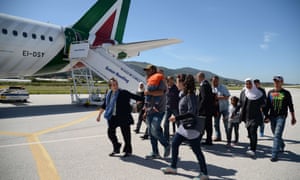
stance on the crisis, Pope Francis took 12 refugees back to the Vatican.
An official confirmed all those taken from the camp were Syrian
Muslims, six of them minors who arrived Lesbos before the deportation deal came into effect.
A group of Syrian refugees arrive to board a plane to travel to Italy
with Pope Francis Photograph: Filippo Monteforte/AFP/Getty Images
A spokesman for the Holy See said: “The pope has desired to make a
gesture of welcome regarding refugees, accompanying on his plane to Rome
three families of refugees from Syria, 12 people in all, including six
children.
“Two families come from Damascus, and one from Deir Azzor (in the
area occupied by Isis). Their homes had been bombed. The Vatican will
take responsibility for bringing in and maintaining the three families.
The initial hospitality will be taken care of by the Community of
Sant’Egidio.”
The pontiff spent the morning meeting hundreds of migrants and
refugees in a notorious detention centre on the island. Men and women
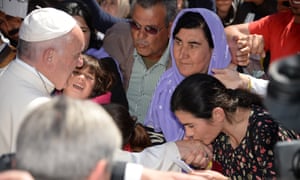
held in the camp wept as he toured the site.
A woman kisses the hand of Pope Francis as he greets people at the Moria
refugee camp. Photograph: Filippo Monteforte/AFP/Getty Images
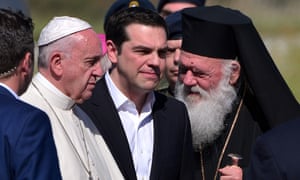
The pope was met at Mytilene’s airport by the Greek prime minister, Alexis Tsipras,
at the start of his biggest effort yet to highlight the humanitarian
crisis unfolding in Europe. Lesbos has borne the brunt of the refugee
influx with more than 850,000 of the 1.1 million Syrians, Afghans and
Iraqis who streamed into Europe last year coming through the island.
“Greece has been an example of humanity,” he said.
The visit is also seen as a further warming of ties between the
western and eastern branches of Christianity, almost a millennium after
their bitter split in 1054.
In a break with protocol, the pope chose to be driven to the detention
camp, in the hills above Mytilene outside the village of Moria, with
Bartholomew.
Addressing refugees, he said: “I am here to tell you, you are not
alone … The Greek people have generously responded to your needs despite
their own difficulties. Yes, so much more needs to be done but let us
thank God that in our suffering he never leaves us alone.
“We hope that the world will heed these scenes of tragic and indeed
desperate need, and respond in a way worthy of our common humanity.”
Advertisement
After
having lunch with eight refugees in Moria, the three church leaders
held a memorial for the victims of migration at Mytilene’s port –
earlier this month the site of the first deportations under the EU-Turkey deal.
Addressing a large crowd, the pontiff issued an appeal for
“responsibility and solidarity” towards refugees from the picturesque
harbour. He said refugees were forced to live in “a climate of angst and
fear and uncertainty over their future”, adding: “Before they are
numbers, refugees are first and foremost human beings.”
Greece’s leftist-led government described Saturday’s visit of
religious leaders as extremely significant. Tsipras was expected to
underline Greece’s increasingly fragile situation in talks with the
pope.
The country has been struggling to house refugees in makeshift
facilities even though the number of arrivals has dropped dramatically
since the deportation deal came into effect on 20 March.
For detainees who have arrived since then, conditions have
deteriorated dramatically. Human rights organisations have withdrawn
from Moria and other detention centres for fear of being associated with
an operation of mass expulsions.
On Friday, just hours before Francis’ scheduled visit, detainees in
the Lesbos camp chanted “freedom, freedom” as demonstrators denounced
their incarceration.
Standing under the razor wire-topped fence, Sham Jutt, a young
Pakistani, spoke of the refugees’ plight, saying he hoped the pope could
intervene. “We expected a life of hope and now he is our only hope,”
said the 21-year-old, adding that he had seen the camp change from being
a registration centre to a prison following the controversial pact the
EU signed with Turkey.
“Now, with this agreement, we are very afraid they will deport us,” he said.
Before the church leaders’ visit, authorities had gone out of their
way to clean up the camp, whitewashing graffiti-splattered walls,
replacing tents with containers, installing air conditioning and taking
families out of the overcrowded facility to an open-air holding centre
nearby.
“In every sense of the word, they have given it a whitewash,” said
Jakob Mamzzak, a volunteer from California. “Today we even heard they
had given [detainees] clean clothes, let them have their first shower in
25 days and brought them good food when the truth is conditions are
inhumane.”
Pope Francis is greeted by the Greek prime minister, Alexis Tsipras
(centre) and Archbishop Ieronymos. Photograph: Louisa
Gouliamaki/AFP/Getty Images
Lesbos’s refugee solidarity movement was hoping the pope could bring
international attention to the problem. “Since this crisis began we have
acted in solidarity with refugees,” said Nikos Zartamopoulos who, with
others in the communist-aligned Pame trade union, had demonstrated
outside the camp. “We are not against the pope per se. If he can speak
out, if he can highlight their plight so much the better.”
The trip came as the head of the Catholic church in England and Wales
said the UK’s refugee resettlement programme set up by David Cameron
was a “great disappointment”. Cardinal Vincent Nichols said Britain’s response to the crisis
was “going very slowly” and called for a major increase in the number
of people being taken in. Asked if he believed governments needed to
show more humanity, the archbishop of Westminster replied: “I do.”
He told BBC Radio 4’s Today programme: “I think we have the resources
as a very rich country. Think of a country like the Lebanon and some of
the other Middle Eastern countries where they have a proportion of
refugees present which represents 30-40% of the population and they
cope.
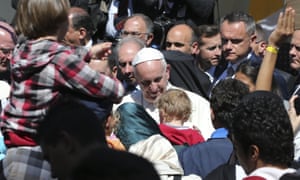
Pope Francis meets refugees on Lesbos Photograph: Petros Giannakouris/AP
“We are a very rich country and I think with a greater cohesiveness
between a spirit of willingness that is there among many and mechanisms
which governments can put into place, we could be doing more.
Advertisement
“There
are aspects of the government policy that are commendable but I’ve said
surely that can be speeded up. Surely in the first year we can see
really how many could be taken and then multiply that by five. At the
moment it’s going very slowly and it’s a great disappointment.”
David Cameron announced plans to resettle 20,000 Syrian refugees in Britain at the height of the crisis. The scheme will cost more than £500m, the government said earlier this week.
Nichols dismissed suggestions that the UK should not be taking in
refugees because some Britons are struggling to make ends meet.
“I don’t think the struggle of people in the destroyed villages in
and around Mosul and other parts of Syria, those struggles are not the
same as our struggles,” he said.
“They are people like ourselves and they are desperate and we should
open our hearts as well as our political and financial resources.”


No comments:
Post a Comment